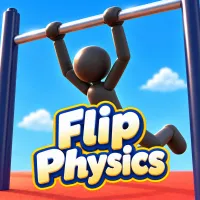
In Flip Physics, a skill-based gymnastics and parkour simulation, all aerial attempts depend on the precise timing of releases while manual body movement and ragdoll physics dictate swings, flips and landings.
MOMENTUM ALONG THE HORIZONTAL BAR
Swing back and forth to get some momentum and then let go of the horizontal bar. Your swing amplitude determines the movement you have for your launch, and your release timing affects height, direction and number of rotations. Arching increases your movement, and tucking increases the speed of airborne rotations. Body position is important throughout the stunt, as backflips, frontflips and twists require different combinations of momentum and posture.
Why Regrab the Horizontal Bar
An aerial sequence can continue beyond its initial launch. Return toward the bar after completing your movements and attempt a catch to extend the performance. Successful regrabs create opportunities for longer combos and higher achievement scores in Flip Physics. This connects aerial control with another precise task: returning your athlete to a position where the bar can be caught.
When Aerial Sequences Become Performances
Artistic poses add movements to your athlete’s routine, and you can record the entire performance. Longer sequences therefore combine launches, airborne posture changes, and catches rather than ending after one flip. Repeated attempts provide opportunities to adjust swing flow and release timing. Changing these inputs affects the next flight path and the rotations you can complete.
Start Swinging and Select Body Positions
Left-click or press Spacebar to start. Use J or Up Arrow to arch, K or Down Arrow to tuck, L or Left Arrow for layout, and I or Right Arrow for pike.
Press O for flash, U for squat, and S for stick. Q twists left, while W twists right.
A RELEASE THAT SUPPORTS ANOTHER CATCH
Extended routines come from controlled launches and deliberate changes of posture. Tweak a Flip Physics sequence for a timed release, aerial combo and regrab stuck on a bar.